Case study
VIGIL
A multi-agent AI platform that watches live infrastructure data, flags anomalies, and recommends actions, with humans approving every consequential change.
The problem
Railways, satellites, and power grids fail quietly. The bottleneck is rarely the hardware. It is attention: a small team of operators cannot watch every signal at once.
VIGIL is built around one idea. Let software watch everything, all the time, and bring a person in only when a decision is needed.
What I built
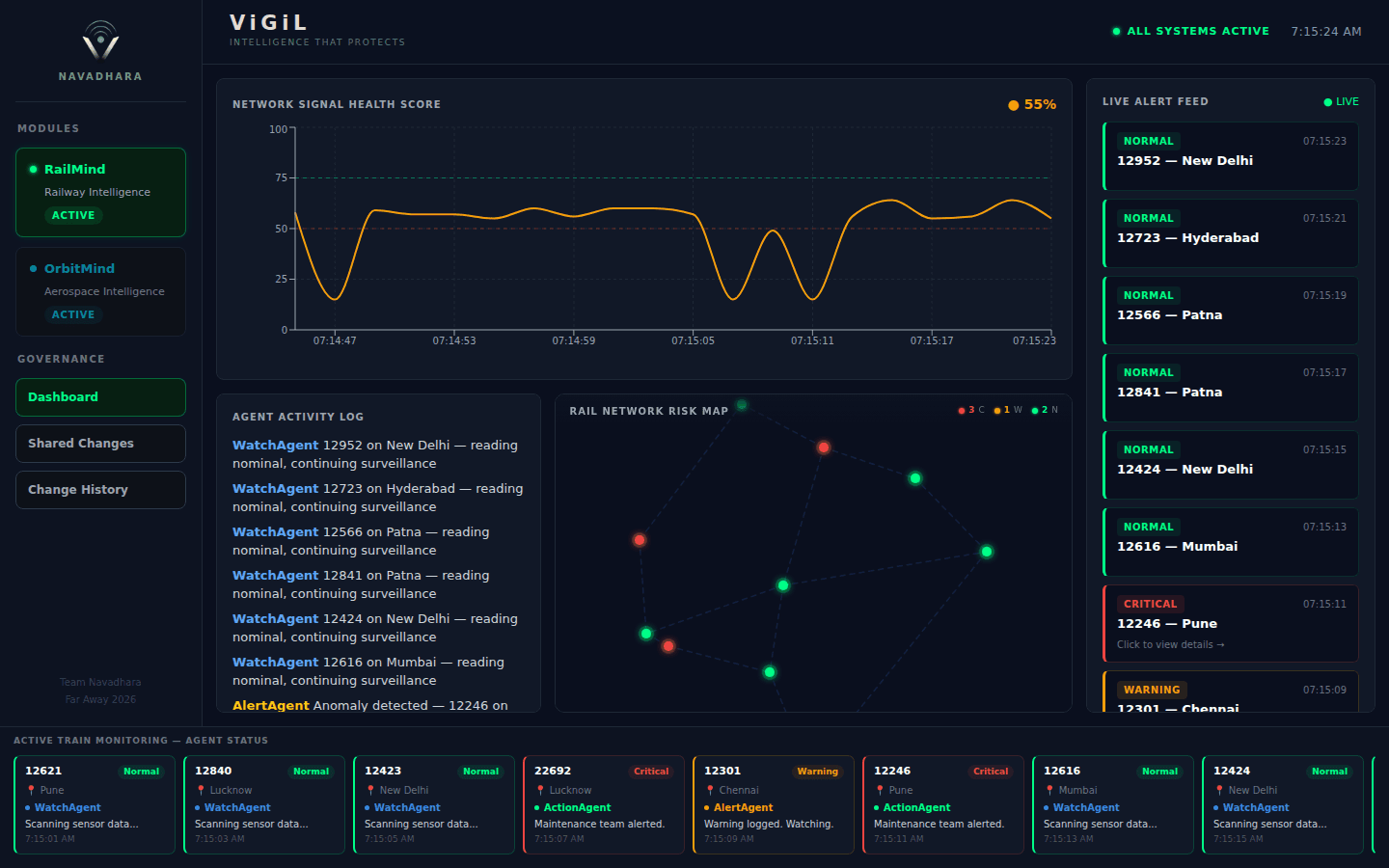
I led the web dashboard and the integration between the front end and the services behind it. That meant turning live sensor data and agent output into one screen an operator can read at a glance: a live health chart, a severity-ranked alert feed, a running agent log, a map of train risk, and a strip of per-train status.
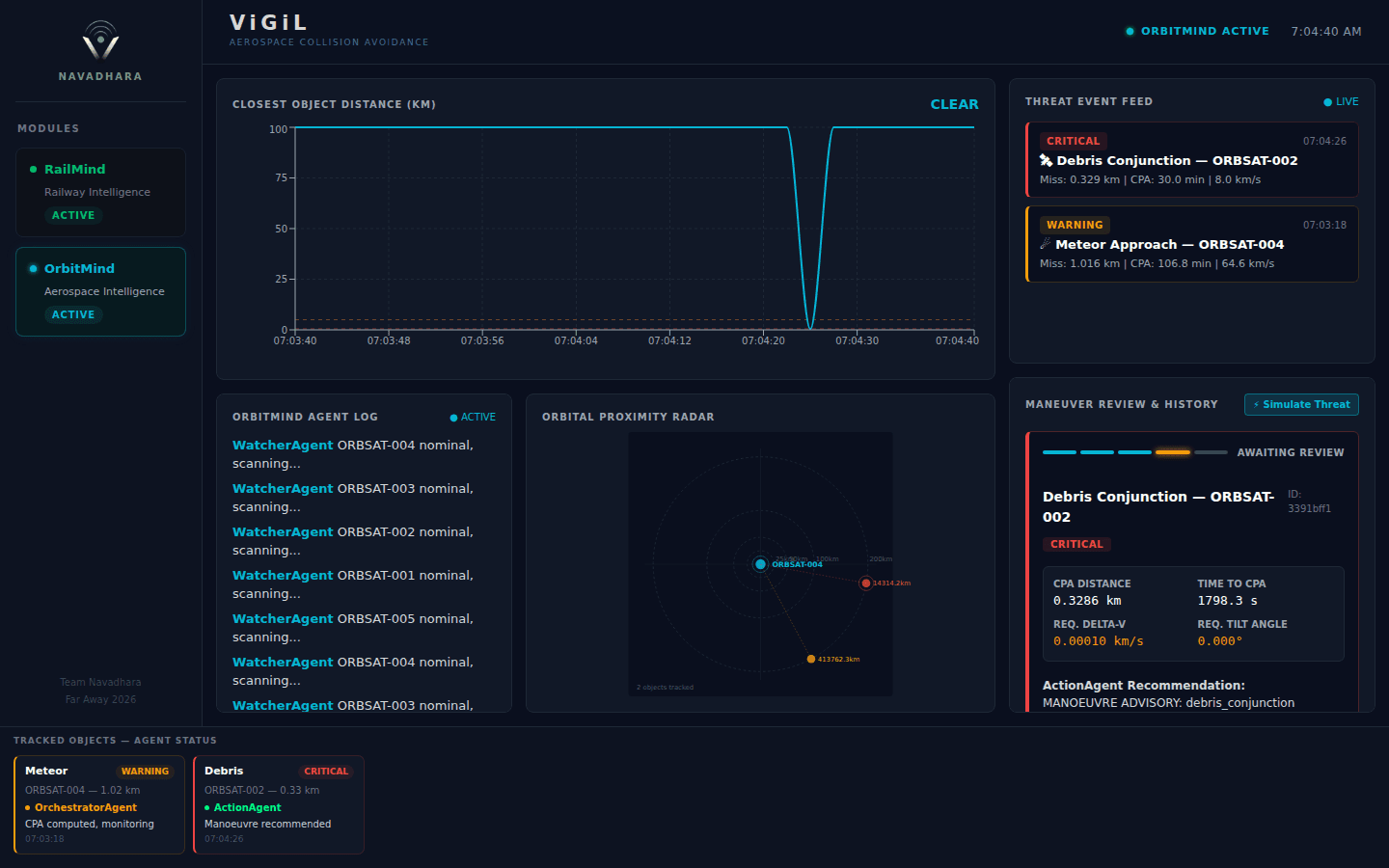
The dashboard hosts both modules behind a single module switcher, so adding a new domain does not mean building a new app. It also covers the approval screens: a shared-changes queue, a change history, and a step-by-step lifecycle view for each proposal.
How it works
Three agents run as a pipeline. A watcher ingests the sensor stream, an alert agent classifies each reading as normal, warning, or critical, and an action agent turns anomalies into plain-English recommendations using an LLM.
RailMind scores readings with an Isolation Forest model. OrbitMind takes a different route on purpose: closest-approach and delta-v are computed with exact vector math, and the LLM only explains numbers it is handed. In collision avoidance, a hallucinated figure is not an option.
Decisions worth noting
Human-in-the-loop by design. A threshold change in RailMind needs two approvals from two different operators, and a single rejection vetoes it. OrbitMind will not act on a manoeuvre until a person approves it.
The approval engine knows nothing about railways. Domain rules live in a small validator registry, so a new kind of change is one entry, not a rewrite.
Need something like this?
Tell me what you're building and where you're stuck. I'll reply within 24 hours.